+ +

CASE STUDY → DESIGN SYSTEM & ENGINEERING

EVOLOK — Design Infrastructure for a 13-Brand Media Ecosystem

12 brands. 12 independent squads. No shared system. Every campaign started from zero.

PERIOD
2022 — 2026 · Ongoing
COMPANY
Vocento — Spain's largest media group
ROLE
Lead · Senior Product UX/UI & Behavioral Design Specialist
Sole architect of the system — design, engineering and documentation
SCOPE
12 editorial brands + 3 corporate portals
ABC · El Correo · El Diario Vasco · La Rioja · El Diario Montañés
El Comercio · El Norte de Castilla · Las Provincias · La Verdad
Hoy · Ideal · Diario Sur · Sumauto · MujerHoy · Vocento
SYSTEM NAME
EVOLOK 2.0

Design infrastructure that keeps tokens, components and delivery synchronized — across teams you don’t control.

Design system & engineering — scalable tokens and components

01 — THE PROBLEM

A system nobody had built — so everything broke constantly

Vocento's 12 editorial brands each operated their own subscription campaigns. Each brand had its own CSS files, its own component interpretations, its own way of handling paywalls and banners. There was no shared architecture — only informal reuse that generated inconsistencies faster than any team could fix them.

The consequence was structural. Designers worked in Figma. Developers read Figma manually and translated it to CSS by hand. Every token change required a full cycle of versioning, review, and correction. Every campaign brief meant starting from scratch across 12 brands simultaneously.

The system wasn't fragile by accident. It was fragile by default — because no system existed.

The system wasn't fragile by accident. It was fragile by default — because no system existed.

Diagnosis: three layers of the same failure — business, product/UX and engineering.

DIAGNOSIS GRID

A system nobody had built — so everything broke constantly

The consequence was structural across the business, product/UX, and engineering layers.

VIABILITY

Business

No consistent visual language across brands or campaigns. A/B testing was statistically unreliable — every variant was built differently, making comparison impossible. Time-to-market required 10+ days per campaign cycle. External teams were repeatedly contracted to cover capacity gaps that a shared system would have eliminated.

DESIRABILITY

Product / UX

Subscribers encountered different visual experiences depending on which brand they accessed. Paywalls, banners and checkout flows used inconsistent patterns, eroding trust at the moment of highest conversion intent. No design baseline meant no measurable UX improvement over time.

FEASIBILITY

Engineering

No shared CSS architecture meant constant duplication, uncontrolled dependencies, and files so large they became unmaintainable. There was no Git versioning. Refactors were continuous. Every developer on every brand team was solving the same problems independently — and solving them differently.

02 — THE BASELINE

What "before" actually looked like

These weren't exceptional cases. This was the operational baseline every sprint.

Operational baseline Launching campaigns and running experiments required manual rebuilds across brands.

Baseline metrics

Before EVOLOK

Launching a campaign across all brands: ~10.5 days.
Making a small visual change: ~1 full day.
Creating a new variant for A/B testing: 1+ hours.
Reusable components: none.
Documentation: none.
Shared versioning: none.

03 — THE DECISION

We could have built a Figma library. That wasn't the problem.

The obvious move was to create a component library in Figma and a corresponding CSS file. Most teams in this situation build exactly that — and within 12 months, it fragments again, because the problem isn't components. It's the gap between design and code.

Every manual handoff is a place where the system can break. Every token that exists in Figma but must be translated into CSS by a developer is a source of drift. A design system maintained through human discipline will always degrade faster than one maintained through automation.

The constraint I set: the system had to be self-maintaining. Not enforced through process — enforced through architecture.

RULED OUT

A Figma library + manual CSS

Would have reproduced the same fragmentation under a new visual layer. Teams would have adapted components independently within 18 months. The handoff gap would have remained.

RULED OUT

A centrally enforced style guide

No authority to enforce it across 12 independent squads. Any solution depending on team compliance would fail on first contact with a regional campaign deadline.

COMMITTED TO

An automated design-to-code pipeline

Figma as the single source of truth. MCP (Model Context Protocol) as the synchronization layer. CSS as the output — automatically generated, never manually translated. Consistency guaranteed by the system itself, not by process.

04 — THE SYSTEM · ARCHITECTURE

EVOLOK 2.0 — one file, eleven themes, zero manual translation

The system is built on a single principle: what exists in Figma must exist in CSS automatically. No human in between.

04 — THE SYSTEM · ECOSYSTEM

One architecture, thirteen brands

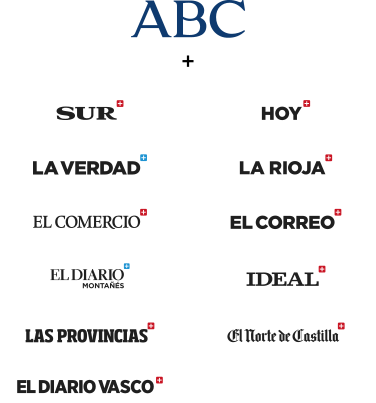
The regional bundle integrated Vocento's local newspapers into the same subscription architecture. Subscribers could combine ABC with regional titles — El Correo, Diario Vasco, Diario Montañés, El Comercio, La Rioja, Las Provincias, El Norte de Castilla, Hoy, Sur, Ideal and La Verdad.

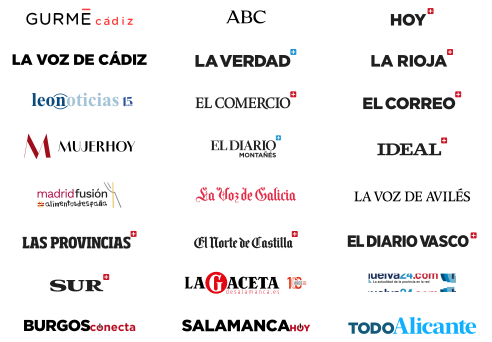
The platform was deployed across all publications. One shared core. Local customization at the surface. Every brand team got the same foundation, with the ability to adapt tone and messaging without touching the underlying architecture.

Regional bundle partners

The regional bundle let subscribers combine ABC with selected local newspapers, creating a unified national-regional subscription. Flagship national content plus trusted regional journalism — higher perceived value, preserved editorial identity.

Vocento media ecosystem

The subscription architecture scaled across Vocento's full multi-brand ecosystem, integrating national and regional publications on the same platform while each brand kept its editorial identity and audience focus.

04 — THE SYSTEM · COMPONENTS

Three entry points, one conversion logic

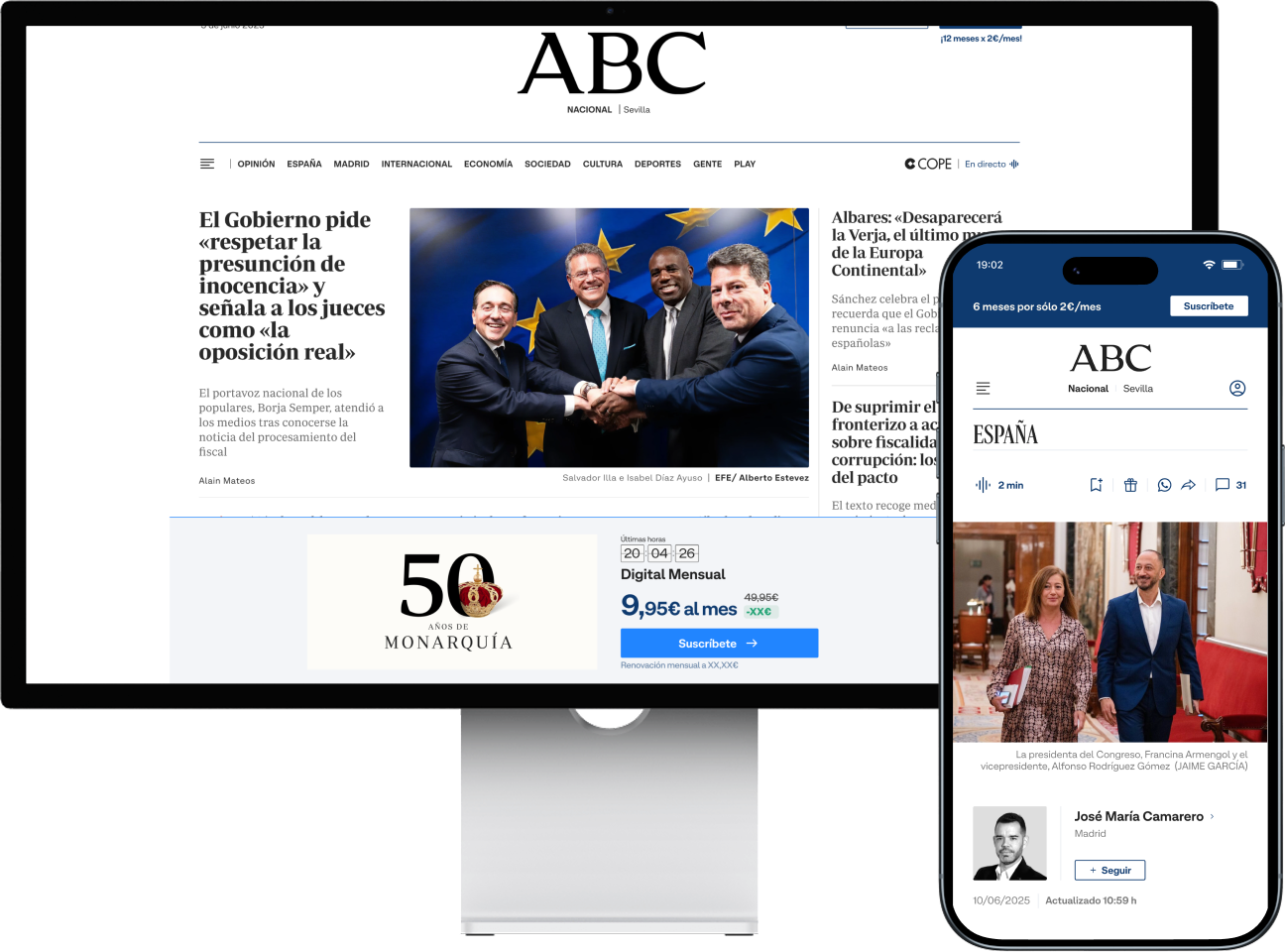
The subscription experience was built as a behavioral conversion system composed of coordinated entry points across the reading journey. Each component addresses a different conversion moment: persistent trigger, decision moment, or high-attention interruption.

Banner bottom — persistent trigger

A low-friction conversion trigger that runs alongside the reading experience. Continuous subscription visibility without interrupting article consumption.

Banner bottom — Variant A

Banner bottom — Variant B

Paywall — decision moment

Redesigned to simplify decision-making and create a clear offer hierarchy. Instead of fragmented subscription combinations, a simplified set of plans structured for fast comparison.

Paywall — Variant A

Paywall — Variant B

Pop-up — high-attention moment

Designed as a focused conversion moment inside the reading flow. Unlike the persistent banner, the pop-up concentrates attention on a single offer and strips out any cognitive overhead.

Pop-up — Variant A

Pop-up — Variant B

04 — THE SYSTEM · STORE

From product catalog to guided decision

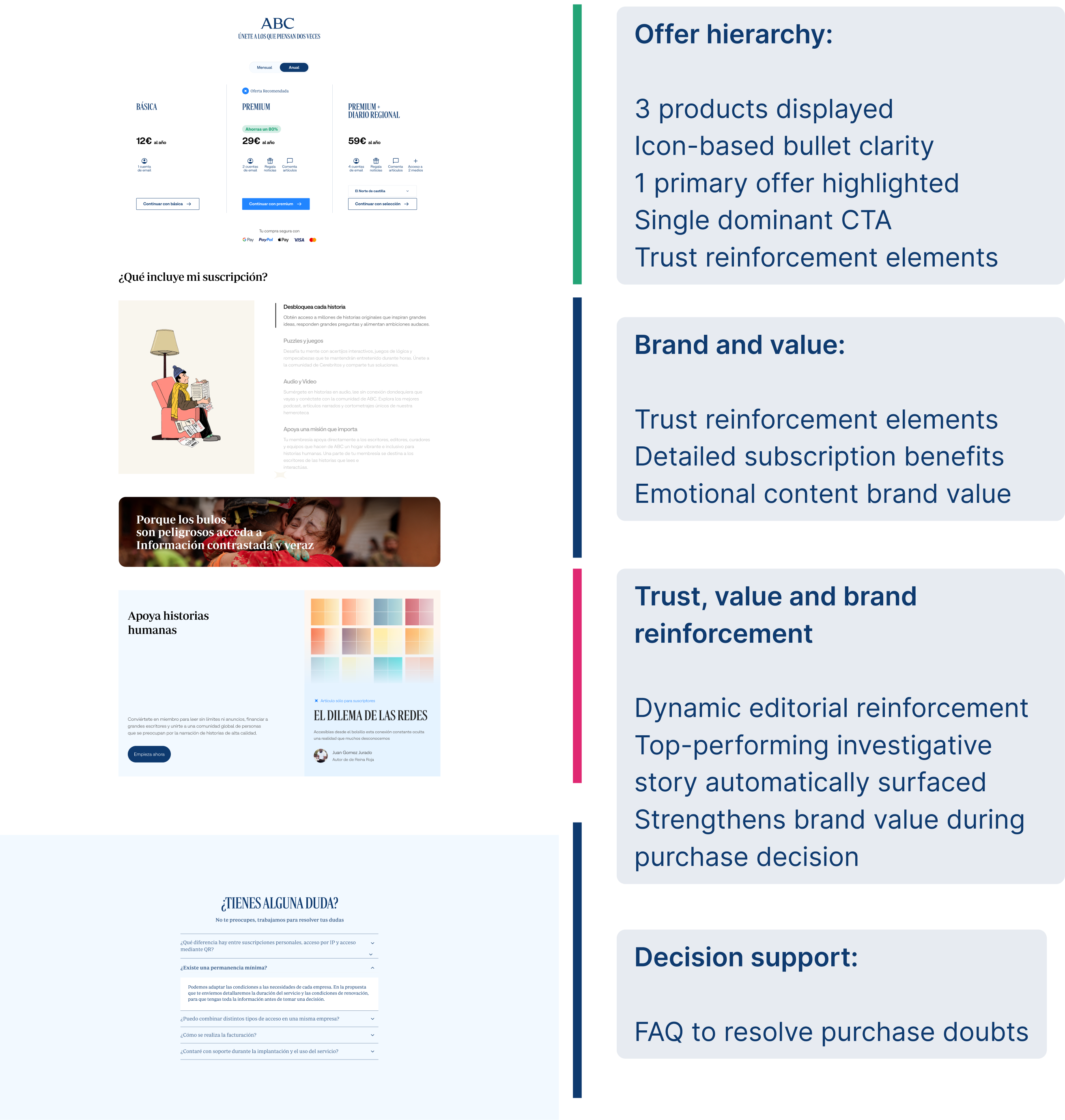
The store was the highest-intent surface and the highest drop-off point. Its fragmented structure was the single biggest blocker to subscription conversion across the ecosystem.

The redesign was grounded in behavioral research: choice architecture, information hierarchy and perceived value. Every element was tied to a decision-theory reference — because every element had to be defensible across 13 brand teams.

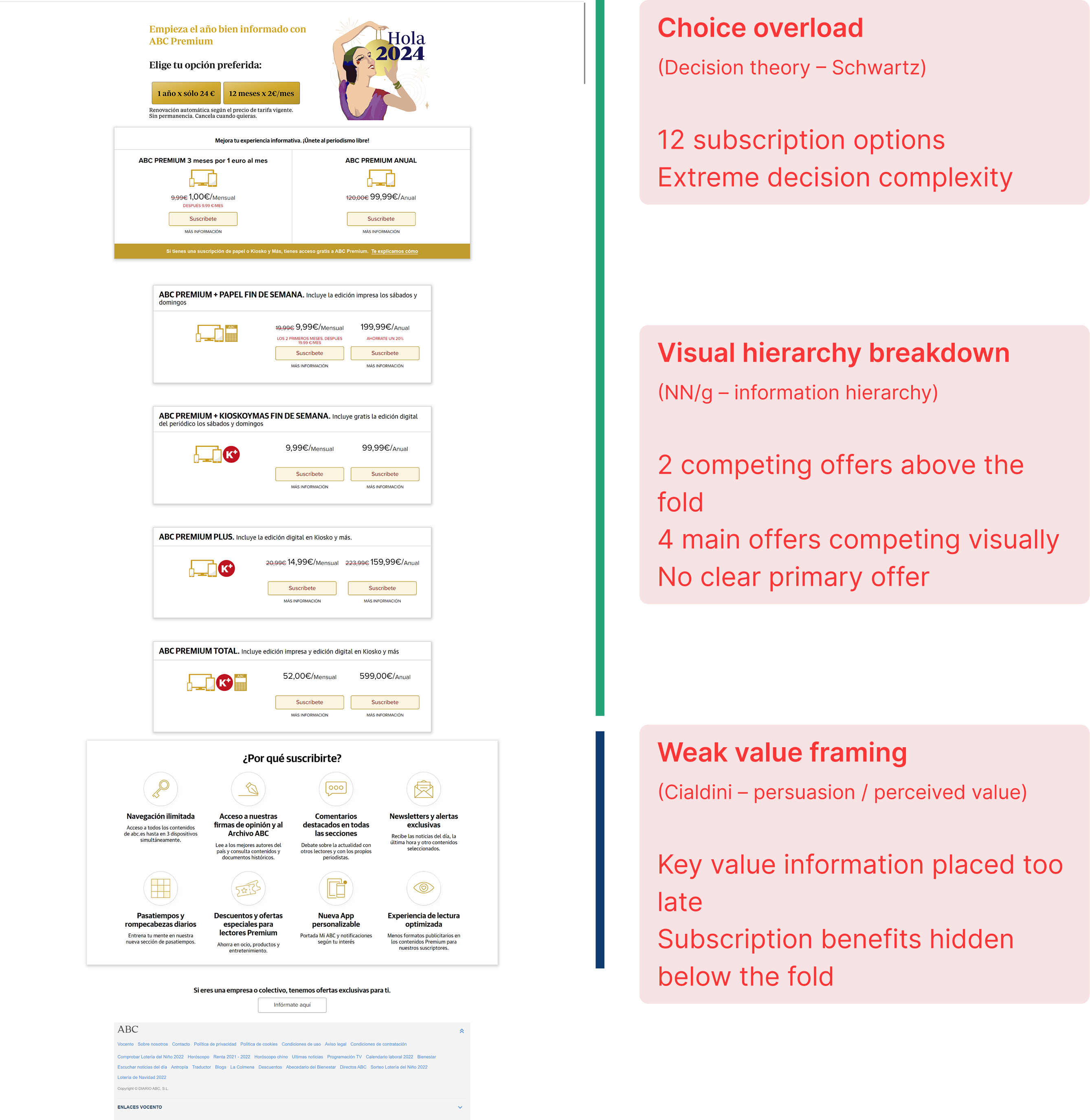
Before

Subscription store before redesign — fragmented offers and weak hierarchy

Too many options without a clear hierarchy. Multiple offers competed for attention. Cognitive load made the purchase decision unnecessarily complex.

After — +35% CTR

Subscription store after redesign — guided decision and +35% CTR

Clear hierarchy. Scannable structure. Strong visual emphasis. High-performing editorial content surfaced at the moment of decision to reinforce perceived value.

Learning

The store stopped being a product catalog and started being a guided decision. Scannability, hierarchy and editorial reinforcement turned the page into the highest-performing conversion surface in the system.

04 — THE SYSTEM · CHECKOUT

Reducing friction at the moment of highest intent

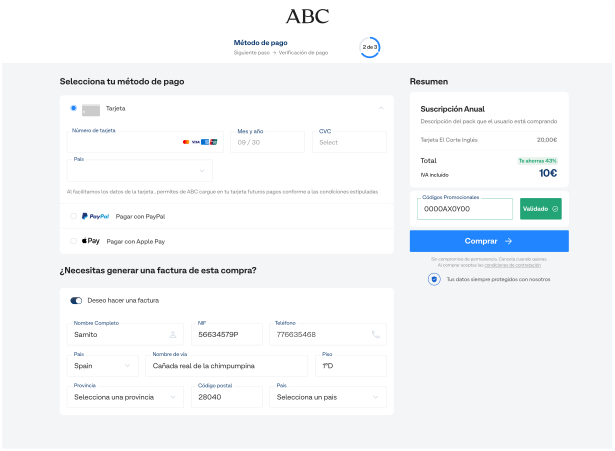
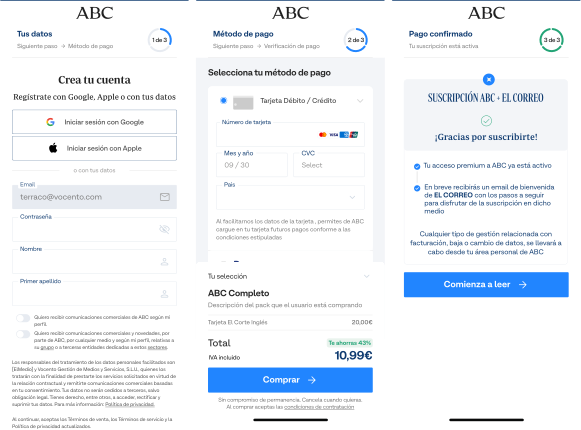
Checkout was the point of highest conversion intent and the point of highest drop-off. Progressive disclosure across desktop and mobile reduced cognitive load at the exact moment users decided whether to trust the transaction.

Desktop — baby steps + progress indicator
Desktop checkout flow with baby steps and progress indicator
Mobile — baby steps + progress indicator
Mobile checkout flow with baby steps and progress indicator

Total volume (ABC + Media)

149,493

Jun 2023 118,380 Feb 2025 149,493

+31,113 net subscribers from checkout friction reduction

ABC volume

54,461

Jun 2023 39,115 Feb 2025 54,461

+39.2% growth driven by simplified payment flows

ARPU (Media)

€110.64

Jun 2024 €110.27 Feb 2025 €110.64

Premium value maintained despite high-volume acquisition

Monthly churn (Media)

4.35%

Jun 2023 5.11% Feb 2025 4.35%

Net reduction in post-sale friction

Monthly churn (ABC)

3.10%

Jun 2023 4.07% Feb 2025 3.10%

−23.8% abandonment rate after checkout redesign

Billing churn (Group)

3.63%

2023 3.72% 2024 3.63%

Stabilized across the group under unified system

05 — THE SCALE PROBLEM

Designing for 12 squads you don't control

Adoption couldn't be mandated — it had to be earned. The strategy was simple: make the shared system easier to use than building independently.

The system had to work with independent brand teams, their own calendars, and their own constraints — without breaking consistency.

ADOPTION

One CSS file. One link tag. One class.

The barrier to adoption was lower than the barrier to building anything custom.

ENFORCEMENT

Self-policing by versioning

Git versioning and explicit naming conventions made the system self-policing. Deprecated components are flagged red in Figma and in documentation simultaneously.

AUTOMATION

Remove manual translation

MCP eliminates the class of errors that comes from human translation. If a token exists in Figma, it exists in CSS.

06 — RESULTS

Numbers that changed how teams operate

Campaign creation

2 days

Before: ~10.5 days across all brands. After: 2 days. ~85% reduction.

Small changes

Minutes

Before: ~1 full day. After: minutes. ~95% reduction.

Variant creation

5 min

Before: 1+ hours. After: 5 minutes. ~92% reduction.

Teams using the system

12+

12+ editorial squads + 3 corporate portals.

Operational shift

The system didn't just improve metrics — it changed how teams spend their time.

Campaign build time

Before 6 weeks
After 5 days

Build vs strategy

Before 90 / 10
Build
Strategy
After 20 / 80

A/B tests per month

Before 1 test
After 15 tests

Brief to live campaign

3 Weeks

5 Days

The clearest signal the system worked. Not a prototype metric — a production reality across 13 brands.

07 — REFLECTION

What building infrastructure at this scale taught me

The most important insight from this project is the difference between a design system and design infrastructure. A design system is a collection of components. Infrastructure is the system that keeps components synchronized, documented, and deployable across teams that don't coordinate directly.

EVOLOK started as the former and became the latter. The shift happened when I stopped thinking about components and started thinking about the pipeline — the flow from design decision to shipped code, and every place that flow could break.

Manual translation between design and code is not a process problem — it's a structural one. The only reliable fix is to remove the manual step.

What I'd do differently

Implement MCP from day one, not as a later optimization. The manual translation phase cost months of drift that the automated pipeline would have prevented. Validate the synchronization pipeline with real teams before scaling — the technical architecture was sound, but adoption would have been faster with earlier real-world testing.